
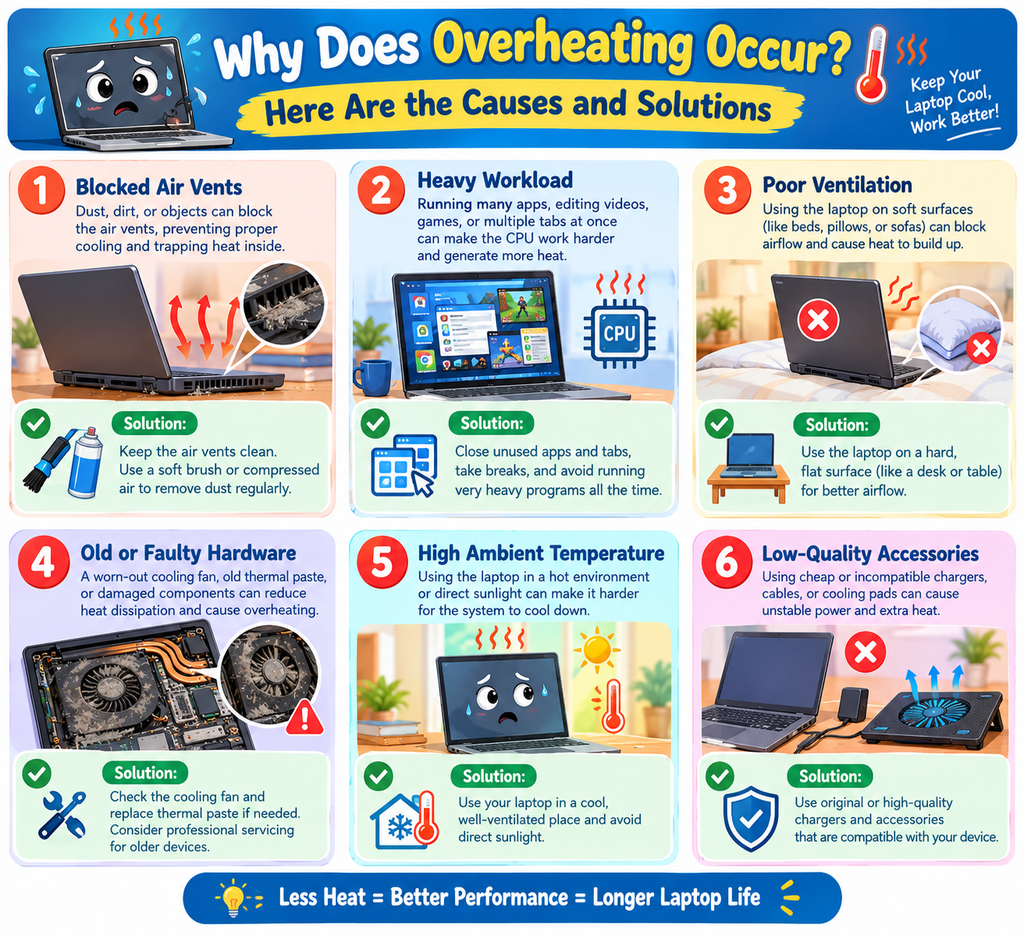
Why Does Overheating Occur? Here Are the Causes and Solutions. Overheating happens when a mechanical system or electronic device generates more thermal energy than its cooling system can dissipate. In modern computers, smartphones, and automotive engines, every operation creates friction or electrical resistance that converts into ambient heat. Under normal operating conditions, integrated cooling components—such as heat sinks, cooling fans, liquid coolants, and thermal paste—keep working temperatures within a safe range. However, when these cooling systems fail or work past their limits, internal temperatures rise rapidly beyond standard operating thresholds.
       OPERATING HEAT GENERATION
  (CPU / GPU Workload or Engine Power)
                   │
                   ▼
     ┌──────────────────────────┐
     │ Cooling System Dissipates │
     │  Heat via Air/Liquid     │
     └─────────────┬────────────┘
                   │
          Is Heat Output >
         Cooling Capacity?
          ┌────────┴────────┐
          │                 │
         YES                NO
          │                 │
          ▼                 ▼
   ┌─────────────┐   ┌─────────────┐
   │ OVERHEATING │   │ NORMAL TEMP │
   │   OCCURS    │   │ OPERATION   │
   └─────────────┘   └─────────────┘
The table below outlines the standard operating temperature ranges compared to dangerous thermal thresholds across everyday systems:
| Device / System Type | Normal Operating Range | Warning / Throttle Zone | Critical Overheating Threshold |
|---|---|---|---|
| Desktop / Laptop CPU | 40°C – 70°C (104°F – 158°F) | 80°C – 90°C (176°F – 194°F) | 95°C+ (203°F+) |
| Graphics Card (GPU) | 55°C – 75°C (131°F – 167°F) | 83°C – 89°C (181°F – 192°F) | 90°C+ (194°F+) |
| Smartphones (iOS / Android) | 20°C – 35°C (68°F – 95°F) | 37°C – 43°C (98°F – 109°F) | 45°C+ (113°F+) |
| Automotive Engine | 90°C – 105°C (195°F – 220°F) | 106°C – 115°C (222°F – 239°F) | 120°C+ (248°F+) |
Defining Overheating in Modern Devices and Machines
To understand why does overheating occur, you must first look at modern hardware architecture. Central processing units (CPU) and graphics processing units (GPU) consist of billions of microscopic transistors packed onto tiny silicon dies. As electric current flows through these transistors, electrical energy is converted directly into heat energy.
Car engines generate thermal energy through continuous internal combustion, where controlled explosions reach temperatures over 1,000°C inside the combustion chambers. When thermal regulation fails, silicon chips expand, liquid fluids degrade, and physical metals begin to warp.
The Hidden Dangers of Ignoring High Temperatures. Why Does Overheating Occur? Here Are the Causes and Solutions
Ignoring high temperatures in your devices or vehicle leads to cumulative hardware damage and performance degradation. Modern processors feature built-in protective features like thermal throttling, where the system automatically slows clock speeds down to reduce heat output. While thermal throttling prevents immediate failure, running hardware at high temperatures for long periods degrades silicon circuits and shortens component lifespans.
Why Does Overheating Occur? Here Are the Causes and Solutions
In automotive engines, severe heat buildup can warp cylinder heads, destroy head gaskets, and cause internal engine seizure, resulting in high repair bills. Lithium-ion batteries in smartphones and laptops are also sensitive to heat. Exposure to temperatures above 60°C (140°F) causes chemical breakdown, reduced battery capacity, thermal runaway, swelling, and potential safety risks.